viernes, 24 de octubre de 2008


Larry DiMarzio's conversation with Joe Satriani NAMM 2008
Hoy tuve el gran privilegio de ir al concierto del que es considerado el mejor guitarrista de nuestra era: Joe Satriani. Verdaderamente una experiencia inolvidable ver de primera mano la capacidad individual de alcanzar realizar música tan compleja.
Esta es una entrevista en la que Satriani explica un poco de cómo ha sido crear sus propias guitarras y comenta además su proceso mental para realizar música.
Verdaderamente increíble!!!
Alejandro Beeche Van der Laat
viernes, 17 de octubre de 2008
W. y Abel Pal´Techo

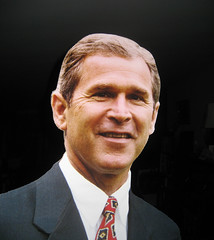
¿Se parecen verdad? Pero no físicamente, sino en su rol presidencial. Este fin de semana empieza en Estados Unidos el estreno de la película W., que según analistas resultó no ser una película propagandística atacando desde la izquierda a Bush, sino más bien una reseña más biográfica. Según estos analistas, la historia de Bush es la de un hombre sencillo que le "tocó" estar en la posición de estar en la silla donde se deben tomar las decisiones más complejas. Un hombre que de joven no le gustaba trabajar y le gustaba tomar cerveza desde el medio día, y que luego dejó la cerveza cuando encontró a Dios. Un hombre que ganó la aceptación del pueblo por sus frases coloquiales, que muchas veces agradaban de más por la inocencia de su mensaje. En reseña, un hombre que inevitablemente le quedó el puesto grande.
No se si a Abel de joven le gustaba tomar cerveza antes del mediodía, pero dejando esto de lado, estos dos personajes parecen haber sido dibujados de la misma caricatura.
Alejandro Beeche Van der Laat
No se si a Abel de joven le gustaba tomar cerveza antes del mediodía, pero dejando esto de lado, estos dos personajes parecen haber sido dibujados de la misma caricatura.
Alejandro Beeche Van der Laat
sábado, 11 de octubre de 2008
Fórmula hacia la ingobernabilidad: Situación del Estadio Nacional
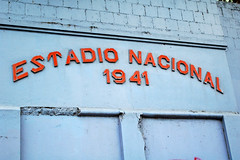 He seguido las recientes discusiones que han brotado en Palestra Económica sobre el tema de la suspensión de la construcción del Estadio Nacional.
Para aquellos de nosotros interesados en las políticas públicas es un caso muy interesante de analizar con el fin de entender porque existe ingobernabilidad en el país.
Varias observaciones para respaldar estas aseveraciones:
a) Cualquier ciudadano y hasta aquellos que son abogados de profesión, pueden ser obstruccionistas y ejercer su derecho de expresión y asociación para paralizar el desarrollo del país mediante la suspensión de la construcción del Estadio Nacional. El problema existe cuando el Poder Judicial - Sala Cuarta - del país pierde la perspectiva de su rol - bajo la separación de poderes - y empieza a legislar, acogiendo recursos que extralimitan su legítima interpretación de nuestros derechos constitucionales.
b) Más aún, tomando en consideración lo anterior, con una Sala Cuarta que se extralimita, la consecuencia es que deja de cumplir con su rol constitucional de brindar justicia pronta y cumplida. Esto significa que a pesar de que resuelva a favor de construir el Estadio Nacional en La Sabana, lo hará extemporáneamente y todos los costarricences dejaremos de percibir - queramos o no - los beneficios que brindaría el uso de este estadio durante el tiempo que la Sala dura en resolver.
c) Esto me lleva al siguiente punto que es la visión de corto plazo de los abogados que no piensan en las consecuencias económicas de sus acciones. Un excelente documento para ilustrar esto es, "Lo que se ve y lo que no se ve" de Frédéric Bastiat. Más específicamente, aquellos interesados en participar en la política pública del país y saben de los problemas institucionales que sufrimos (y que he explicado anteriormente) deben responsablemente tomar en consideración las repercusiones a largo plazo de sus acciones (presentando recursos ante la Sala Cuarta): por ejemplo cuantos trabajos dejarán de existir por parte de aquellas personas que trabajarían directa o indirectamente en el Estado Nacional mientras la Sala resuelve.
En fín es frustrante pensar en cómo las agendas personales todavía pueden filtrarse en la frágil institucionalidad del país y detener el desarrollo de nuestro país. Nos falta mucha madurez en un mundo globalizado que crece y no nos espera.
Da mucha pero mucha lástima...
Alejandro Beeche Van der Laat
¿Deberían algunas personas no votar?
 En el último video de John Stossel en 20/20 el tema en cuestión es sí algunas personas no deberían votar, dado el voto poco informado de un gran número de votantes en los Estados Unidos.
Esta pregunta le alza los pelos a más de un ferviente amante de la democracia, que defienden a todas costas nuestro derecho y deber de votar y lo aplauden como uno de los pilares de una sociedad libre y próspera. En Costa Rica lo vivimos recientemente en la votación del referéndum cuando las encuestas demostraban que 9 de cada 10 votantes se determinaba ignorante en cuanto al contenido del TLC.
No es plausible crear una fórmula mágica que determine quién debe votar y quién no, ni ingeniarse un examen elitista que determine quién va a tener derecho de votar, el punto importante es que cada individuo analice su conocimiento de los gobernantes y que conscientemente detemine si responsablemente debe o no votar. Además, poco favor le hacen al sistema político aquellos que hacen aspavientos públicos instando al público a votar, cuando este votante ni siquiera sabe el nombre de los candidatos a la vicepresidencia.
Alejandro Beeche Van der Laat
martes, 30 de septiembre de 2008
Maria Jose Castillo top 5 segunda ronda, latin american
Una tica con una excelente voz. No soy aficionado de este tipo de programas, pero escuché que esta tica estaba participando y que estaba llegando alto en la competencia, y que la recibieron como una estrella en Costa Rica. La verdad me parece importante aplaudir los buenos ejemplos ticos y este es uno.
Alejandro Beeche Van der Laat
sábado, 27 de septiembre de 2008
Recordando a Paul Newman: El Filántropo
Paul Newman. He used his fame to give away his fortune.
Posted Saturday, Sept. 27, 2008, at 10:20 AM ET

The Hole in the Wall Gang Camp opened in Connecticut in 1988 to provide a summer camping experience—fishing, tie-dye, ghost stories, s'mores—for seriously ill children. By 1989, when I started working there as a counselor, virtually everyone on staff would tell some version of the same story: Paul Newman, who had founded the camp when it became clear his little salad-dressing lark was accidentally going to earn him millions, stops by for one of his not-infrequent visits. He plops down at a table in the dining hall next to some kid with leukemia, or HIV, or sickle cell anemia, and starts to eat lunch. One version of the story has the kid look from the picture of Newman on the Newman's Own lemonade carton to Newman himself, then back to the carton and back to Newman again before asking, "Are you lost?" Another version: The kid looks steadily at him and demands, "Are you really Paul Human?"
Newman loved those stories. He loved to talk about the little kids who had no clue who he was, this friendly old guy who kept showing up at camp to take them fishing. While their counselors stammered, star-struck, the campers indulged Newman the way they'd have indulged a particularly friendly hospital blood technician. It took me years to understand why Newman loved being at the Hole in the Wall Gang Camp. It was for precisely the same reason these kids did. When the campers showed up, they became regular kids, despite the catheters and wheelchairs and prosthetic legs. And when Newman showed up, he was a regular guy with blue eyes, despite the Oscar and the racecars and the burgeoning marinara empire. The most striking thing about Paul Newman was that a man who could have blasted through his life demanding "Have you any idea who I am?" invariably wanted to hang out with folks—often little ones—who neither knew nor cared.
For his part, Newman put it all down to luck. In his 1992 introduction to our book about the camp, he tried to explain what impelled him to create the Hole in the Wall: "I wanted, I think, to acknowledge Luck: the chance of it, the benevolence of it in my life, and the brutality of it in the lives of others; made especially savage for children because they may not be allowed the good fortune of a lifetime to correct it." Married to Joanne Woodward, his second wife, for 50 years this winter, Newman always looked at her like something he'd pulled out of a Christmas stocking. He looked at his daughters that way, too. It was like, all these years later, he couldn't quite believe he got to keep them.
Of course, it wasn't all luck. He lost his son, Scott, to a drug overdose in 1978, so in 1980, he founded the Scott Newman Center, which works to prevent substance abuse. When he first began to donate 100 percent of the proceeds from his food company, Newman's Own, to charity, critics accused him of grandiosity. Grandiose? Tell that to the recipients of the quarter-billion dollars he's given away since the company's creation in 1982. First Paul Newman made fresh, healthy food cool, then he and his daughter Nell made organic food cool. Then he went and made corporate giving cool by establishing the Committee Encouraging Corporate Philanthropy. And all this was back in the '90s, before Lance Armstrong bracelets and organic juice boxes.
But Newman never stopped believing he was a regular guy who'd simply been blessed, and well beyond what was fair. So he just kept on paying it forward. He appreciated great ideas for doing good in the world—he collected them the way other people collect their own press clippings—and he didn't care where they came from. Whether you were a college kid, a pediatric oncologist, or a Hollywood tycoon, if you had a nutty plan to make life better for someone, he'd write the check himself or hook you up with somebody who would.
Today there are 11 camps modeled on the Hole in the Wall all around the world, and seven more in the works, including a camp in Hungary and one opening next year in the Middle East. Each summer of the four I spent at Newman's flagship Connecticut camp was a living lesson in how one man can change everything. Terrified parents would deliver their wan, weary kid at the start of the session with warnings and cautions and lists of things not to be attempted. They'd return 10 days later to find the same kid, tanned and bruisey, halfway up a tree or canon-balling into the deep end of the pool. Their wigs or prosthetic arms—props of years spent trying to fit in—were forgotten in the duffel under the bed. Shame, stigma, fear, worry, all vaporized by a few days of being ordinary. In an era in which nearly everyone feels entitled to celebrity and fortune, Newman was always suspicious of both. He used his fame to give away his fortune, and he did that from some unspoken Zen-like conviction that neither had ever really belonged to him in the first place.
Hollywood legend holds that Paul Newman is and will always be larger-than-life, and it's true. Nominated for 10 Oscars, he won one. He was Fast Eddie, Cool Hand Luke, Butch Cassidy. And then there were Those Eyes. But anyone who ever met Paul Newman will probably tell you that he was, in life, a pretty regular-sized guy: A guy with five beautiful daughters and a wonder of a wife, and a rambling country house in Connecticut where he screened movies out in the barn. He was a guy who went out of his way to ensure that everyone else—the thousands of campers, counselors, and volunteers at his camps, the friends he involved in his charities, and the millions of Americans who bought his popcorn—could feel like they were the real star.
Alejandro Beeche Van der Laat
jueves, 25 de septiembre de 2008
The Crisis of Global Statism
A Crisis of Global Statism

The current financial turmoil is a "crisis of capitalism," said a spokesman for Britain's Socialist Workers Party, as good Marxists have been repeating for more than a century. "[A]n unregulated financial system is a disaster," echoed Sheila Rowbotham, professor of gender and labor history at Manchester University. Added a leftist London mayoral candidate, "Capitalism has had its chance and failed; now it's socialism's turn."
I wonder what they have been smoking.
Remember that the financial crisis opened last year with the meltdown of the American subprime mortgage market. At that time, half of the residential mortgages in the United States were already held or guaranteed by Fannie Mae and Freddy Mac, two so-called "government sponsored enterprises" (GSE). Over the past year, the two GSEs have financed four out of five mortgages. Fannie May was created in the wake of the Great Depression by Franklin D. Roosevelt; Freddy Mac by Congress in 1970. Private investors happily bought securities issued by the two GSEs because they knew the federal government would never let these companies fail — which proved true last week when they were entirely taken over by Washington. Before the crisis started, the American mortgage market was a paragon of socialism, unparalleled in any other Western country.
The 1997 Community Reinvestment Act, which prevents mortgage lenders from "discriminating" against minority applicants, did not help sound financial decisions. At every turn of a financial decision, some regulator is lurking.
The American financial system is tightly regulated. Created in 1934, the powerful Securities and Exchange Commission (SEC) enforces regulations on all kinds of financial transactions, from registration of securities to disclosure of corporate information. The 2002 Sarbanes-Oxley Act further extended the intervention domain of the SEC. The US Department of Justice prosecutes CEOs and entrepreneurs, and the convicted targets are often given long jail sentences. On Thursday, the New York attorney general — a would-be Elliot Spitzer or Patrick Fitzgerald — announced that he has started a "wide-ranging investigation into short selling in the financial market."
When Treasury Secretary Hank Paulson says, "I don't believe in raw capitalism without regulation," he is not revealing a scoop. He is reiterating what has been official American policy for the last century. Whether the result is financial socialism with a human capitalist face, or state capitalism with a strong socialist flavor, it is a matter of choosing between a half-empty and a half-full glass.
The partial exportation of American regulation to other countries has led to a sort of global financial statism.
Another source of financial turmoil has been the brisk increase in the money supply by the American central bank, the Federal Reserve System, as indicated in higher inflation and low interest rates. For many years, economists of the so-called "Austrian" school of economics (in the wake of late Nobel prizewinner Friedrich Hayek and Ludwig von Mises) have warned us of an impending disaster if money is pumped into the economy to prevent necessary adjustments. This, they claimed, will ultimately bring a worse crisis.
There is no inherent reason to trust the state to regulate efficiently. The state is made of men (politicians and bureaucrats) who respond to their own incentives and interests. If there is a political gain to be made from expanding mortgages and postponing a crisis for future politicians to deal with, it will be pursued.

Despite this, a false confidence in the power of the state to guarantee stability has developed. Some investors have come to believe that, whatever mistake they make, they have a right to their profits, and the authorities will enforce it. The rescue of Bear Stearns, the two GSEs and AIG will only fuel this belief. But if some people have made bad investments and are relieved from their responsibility for their own mistakes, it only means that the cost will be transferred to others, probably through a worse crisis.
Moreover, as many commentators have remarked, guaranteeing large financial firms from failure will bring calls for regulating them still more tightly. This is an old story: past political interventions create the reasons for new ones.
The present financial turmoil is really a failure of global statism. Socialism has failed once again. Let's try capitalism.
Alejandro Beeche Van der Laat
Understanding the Crisis
Understanding the Crisis

"The core issue is that there is nothing to restrain money creation."
What caused this? It is a simple question, and yet answers are all over the map, as you might expect. Here's mine in two words: fiat money.
The word "fiat" here means by order of the state, which is to say that it has no independent worth and is eventually worth nothing. The possibility of precisely that happening emerged in August 15, 1971. Since Nixon severed the last tie of the dollar to gold, the world's monetary system has not been restrained by anything physical. We've depended on the discretion of central bankers. We can't trust that, and this crisis shows precisely why.
Of course there are subsidiary factors: the lifting of restrictions on Freddie and Fannie; subsidized lending; the Fed's artificially low interest rates; the Community Reinvestment Act; financial "deregulation"; the war; Bush profligacy; debt. There is much more besides. But fighting each of these forces individually is like battling down flies at the garbage dump. The core issue is that there is nothing to restrain money creation.
The first time that people hear this, they find their minds rather boggled, and they want to know more. My whole experience in this area is that once people start digging around the area of monetary theory, they find that (1) it is not as difficult a subject as it seems, (2) it is endlessly fascinating, and (3) it explains far more than they realized before.
It was F.A. Hayek who bore this burden most directly for those in the English-speaking world. His books on the source of the business cycle and what to do about it appeared in the late 1920s and throughout the 1930s. These works were cited by the Nobel Prize Committee in 1974 as his most important contribution to economic thought. His ideas are directly applicable to our current plight.

It has been a real tragedy that these works have been out of print. But this year, the Mises Institute made a hard push to get this book out in time for the current financial calamity. We set other projects aside and worked all hours to bring out the definitive collection. Here it is: Prices and Production and Other Works on Money, the Business Cycle and the Gold Standard, by F.A. Hayek.
The book is priceless in its content and presentation. Specifically, Hayek explains the mechanism by which loose credit generates false signals to investors, leading them to chase fads all over the market, and ending in sector-wide failures. He was writing at a time when the gold standard provided partial restraint on the government and the central bank. No more. So Hayek's analysis of all of this is more penetrating than ever. The book also contains the complete text of his many battles with Keynes.

At this link, you can buy what we are calling the Crisis Book Kit at a deep discount. Just click the books you want and the discount happens.
At the same time he was writing, his mentor Ludwig von Mises was battling it out in Austria and the German-speaking world. He became the great opponent of not only inflationary finance but also the Continent's version of the New Deal. The remarkable thing is that these essays were not translated until the 1980s and even then remained obscure. This book is really their first major debut, and it appeared only last year: The Causes of the Economic Crisis. You will see his expository virtuosity at work and also his amazing courage and passion.

It has been a major task of the Austrian school since 1912 to explain to people what money is, how it works, and how its corruption and distortion by the state is the source of both inflation and business cycles. The core book here is Mises's own 1912 classic called The Theory of Money and Credit, written at the dawn of the central banking age. The prose is still crystal clear, and it continues to be the best textbook on money ever written.

In the American context of the Great Depression, one book captures the whole onset and response. It is Murray Rothbard's America's Great Depression. He shows that it wasn't the 1929 crash that was the problem; it was the response to the crash that created the Depression. Bailouts. Price controls. Wage controls. Government programs. Trade restrictions. Crackdowns on the capital markets. And who did all this? It originated not with FDR but with Herbert Hoover — clear echoes of today. There is no understanding the present crisis without this book.

Finally we need to realize the problem of loose money and its effects are not new and not necessarily 20th century. The whole history of the American economy is littered with banking panics, bailouts, business cycles, and chaos, each with the same root. When the money goes bad, everything goes bad. Rothbard chronicles the long history of this in his marvelous book: History of Money and Banking in the United States.
The Mises Institute has sponsored research on this topic since it was created in 1982. Our first conference was on the gold standard. We've suffered for this choice. The best way to fall out of favor with the regime — or its libertarian and neocon supporters — is to question its central bankers. We've done that. But now, the work is done. It is available. The truth is out there. You only need to grab it, comprehend it, and spread it.
Please help. History hangs in the balance.
P.S. For those who want a more extensive collection, see our complete Money and Banking Collection, at an even deeper discount.
Alejandro Beeche Van der Laat
viernes, 12 de septiembre de 2008
Aló Presidente Arias: ¿de que lado estás?

Carta abierta al Presidente de Costa Rica, Óscar Arias, Premio Nobel de la Paz de don Diego Arria, exembajador de Venezuela ante la ONU, y 400 firmas más del Grupo 400+
Caracas, Set. 9, 2008.
Señor Presidente Arias:
Quienes en Venezuela nos confesamos demócratas, estamos alarmados por sus declaraciones en la conferencia de prensa que ofreciera usted en Bruselas alabando la "solidaridad y generosidad" del Presidente de la República Bolivariana de Venezuela, Hugo Chávez, para con otros países.
Sin duda, su deplorable expresión de admiración representa por una parte una confusión entre solidaridad e interés, entre generosidad y expoliación, y por la otra contribuye a la consolidación de un régimen militarista, ladrón y antidemocrático, que no dialoga ni reconoce opiniones distintas a las de Chávez, que fomenta el odio y la discordia entre los venezolanos y entre los latinoamericanos.
Costo político. Es importante que usted, al igual que todos aquellos que se benefician de la supuesta generosidad del Comandante Chávez, entienda que la misma no es gratuita, que tiene propósitos políticos y que sus réditos les serán exigidos en ese ámbito. Ya en una ocasión se la cobró a República Dominicana suspendiéndole el suministro de petróleo, y a Costa Rica amenazando cerrar una planta de aluminio cuando usted dijo que los poderes especiales otorgados al mandatario venezolano eran "la negación de la democracia", en lo cual, por supuesto, tenía y sigue usted teniendo toda la razón.
Permítanos también destacarle que la supuesta generosidad del Comandante Chávez está basada en la disposición de activos que pertenecen a la nación venezolana y no al Gobierno que él preside, y que sobre estos activos su condición presidencial no le da propiedad ni derecho de libre disposición. Igualmente deben estar todos conscientes de que esos donativos son ilegítimos e ilegales, y que no han sido aprobados por los poderes públicos competentes, y que, por lo tanto, están sujetos a revisión y devolución.
En este contexto el propio Comandante Chávez se ha encargado de pregonar que cuenta con los votos incondicionales de los Gobiernos que subsidia, mediante el tratado del ALBA y Petrocaribe, para cuando los necesite, como ocurriría en el caso de considerarse la moción que adelantamos grupos de ciudadanos para llevar ante la OEA, como organización custodia de la Carta Democrática Interamericana, respecto a la violación que a sus preceptos representan un conjunto de leyes impuestas al país mediante decreto del pasado 31 de julio, con las que se modifica de facto la Constitución de Venezuela para convertirlo en un país colectivista, y se encomienda a la fuerza armada la represión de la disidencia.
Libertades amenazadas. Señor Presidente Arias: "Una vez en la historia de América Latina, las armas y los ejércitos estuvieron asociados con la libertad y la independencia. Una vez en la historia, las armas y los ejércitos estuvieron asociados con estabilidad y con respeto a las instituciones públicas. Han cambiado los tiempos. Ahora es la historia de opresión de los pueblos, la de sus tiranías y su dependencia; ahora es la historia de irrespeto a los derechos humanos, de corrupción y de miseria, la que está escrita por las botas de los militares."
Estas fueron algunas de sus palabras ante la Asamblea General de las Naciones Unidas en junio de 1988 que describen cabalmente lo que hoy sufrimos los venezolanos, lo cual hace aún más inexplicable que un hombre de Estado de su prestigio, que lo ha hecho merecedor del premio Nobel de la Paz, alabe a un régimen militarista como el nuestro.
A diferencia de su querido y admirado país, donde "sus libertades nunca fueron amenazadas ni conocieron la humillación de un destino regido por la fuerza", en el nuestro sí lo están, por lo que es deplorable que los países latinoamericanos y caribeños, por los que la democracia venezolana tanto dio, subordinen sus principios y valores a un interés circunstancial, omitiendo además los compromisos que deberían exigir en base en la Carta Democrática Interamericana.
Partido Movimiento Libertario
miércoles, 3 de septiembre de 2008
La convención olvidada
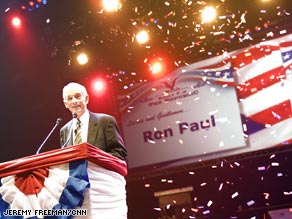 http://www.cnn.com/2008/POLITICS/09/02/paul.convention/index.html?eref=rss_latest#cnnSTCVideo
-----------
"I did not want to run people's lives, I did not want to run the economy and I did not want to run the world. I didn't have the authority to do it, and I didn't have the Constitution behind me to do it," said Paul, who has served in the House of Representatives for more than 30 years.
-----------
Paul blasted the government for what he considered overstepping its boundaries in many areas, including foreign policy, education and taxation.
-----------
He also pointed out that "not one single taxpayer's cent" was spent on the day-long rally.
-----------
The rally marked the official start of Paul's political action group, the Campaign for Liberty.
-----------
Paul is a strict constitutionalist who believes in traditional Republican principles like small government, low taxes and a free-market approach to the economy. But he was the only Republican candidate who voted against the war in Iraq.
-----------
An energetic group joined in as musician Aimee Allen pumped her fists while singing, "Ron Paul. Start a revolution and break down illegal institutions!"
-----------
Paul blasted the government for what he considered overstepping its boundaries in many areas, including foreign policy, education and taxation.
-----------
He also pointed out that "not one single taxpayer's cent" was spent on the day-long rally.
-----------
The rally marked the official start of Paul's political action group, the Campaign for Liberty.
-----------
Paul is a strict constitutionalist who believes in traditional Republican principles like small government, low taxes and a free-market approach to the economy. But he was the only Republican candidate who voted against the war in Iraq.
-----------
An energetic group joined in as musician Aimee Allen pumped her fists while singing, "Ron Paul. Start a revolution and break down illegal institutions!"
Former Minnesota Gov. and professional wrestler Jesse Ventura received wild applause as he ranted against both Democrats and Republicans and hinted at his own White House run.
"I am not a Democrat, and I am not a Republican, and I say that very proudly today, because I think these to parties are destroying our country," he said.
Ventura pushed personal responsibility, saying it's up to Americans to hold leaders and the media to higher standards.
------------
The rally included appearances from NBC's Tucker Carlson, anti-tax advocate Grover Norquist and former New Mexico Gov. Gary Johnson.
The rally included appearances from NBC's Tucker Carlson, anti-tax advocate Grover Norquist and former New Mexico Gov. Gary Johnson.
Rally-goer Carrie Duffield said she attended because she is "dedicated to bringing the GOP back to its traditional, conservative roots of low taxes, low spending, national sovereignty, sound money and a non-interventionalist foreign policy."
------------
Paul said he wanted his rally to be a positive event that focused on the issues he thinks other Republicans ignore: "the spending problems, the deficit, our foreign policy, our national defense, our monetary policy."
"We're Republicans. We believe in limited government and personal liberties. We ought to be talking about these things," he said.
Alejandro Beeche Van der Laat
Paul said he wanted his rally to be a positive event that focused on the issues he thinks other Republicans ignore: "the spending problems, the deficit, our foreign policy, our national defense, our monetary policy."
"We're Republicans. We believe in limited government and personal liberties. We ought to be talking about these things," he said.
domingo, 24 de agosto de 2008
Costo-beneficio de políticas olímpicas
 A propósito del tema de las Olimpiadas, The Economist recién publica esta última semana un artículo en que indica que las Olimpiadas no han traído el boom económico a las empresas chinas que se esperaba. Mucho se debe a las políticas de visa restrictivas de entrada al país, medidas de seguridad y el cierre de negocios y construcciones cercanas a los eventos.
Algunos dirán que el beneficio de las políticas restrictivas chinas es que no han habido casos de atentados. Pero eso sería un análisis muy simplista. Bajo este punto de vista, mejor sería cerrar la entrada total de acceso a las calles y estadios donde se llevan a cabo los eventos para evitar cualquier acto violento. El gran problema es el COSTO que éstas políticas han creado para limitar la libertad de tránsito de las personas que pacíficamente han querido y no han podido entrar a los estadios, la libertad de comercio de aquellos que han querido comprar bienes chinos y no han podido porque se han cerrado los negocios, la libertad empresarial de aquellos que han querido construir sus edificios y no han podido por los cierres gubernamentales, etc.
Al finalizar estas Olimpiadas, sería apropiado para los Londinenses (que realizan las siguientes Olimpiadas) hacer un análisis costo-beneficio de las Olimpiadas de Beijing en comparación con las Olimpiadas pasadas en Atlanta, Barcelona, Atenas, Sydney, etc.. Este análisis no debe ser al estilo chino donde buscan el beneficio de no sufrir atentados a costas de limitar autoritariamente las libertades de muchos sectores económicos, sino más bien al revés: Deben buscar beneficiarse al maximizar los aportes económicos de los visitantes y locales a las olimpiadas, y al mismo tiempo minimizando los costos de posibles atentados.
¿Cómo se minimizan estos costos? Bueno, ahí es donde los londinenses deben aprender desde ahora que sus políticas públicas desde ahora influenciarán y determinarán cuántas restricciones irán a tomar en el futuro. Si aprenden de la experiencia china, entenderán que las restricciones a las libertades políticas a través del tiempo afectaron inevitablemente las libertades económicas durante las Olimpiadas.
Alejandro Beeche Van der Laat
viernes, 8 de agosto de 2008
Diplomacia Olímpica
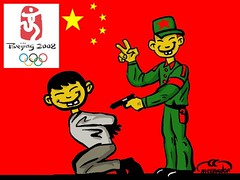 Hoy que empiezan las controvertidas Olimpiadas en Beijing, la gran pregunta latente es cómo se relacionará el régimen autoritario chino con la sociedad olímpica (tanto atletas como visitantes).
Cunado hice la práctica en Search for Common Ground, realizamos un foro sobre La Diplomacia Olímpica, y se analizó el caso de China en los 70´s y actualmente.
Por otro lado, The Economist publica esta última semana una serie de artículos sobre las Olimpiadas en Beijing y describen muy bien las preguntas latentes sobre el resultado político económico de las Olimpiadas.
Alejandro Beeche Van der Laat
sábado, 19 de julio de 2008
¿Porqué el pollo cruzó la calle?
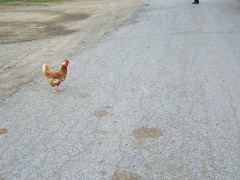 ¿Por que el pollo cruzo la calle?
RENÉ DESCARTES: Para ir al otro lado.
PLATÓN: Por su bien. Al otro lado de la carretera se encuentra la Verdad.
ARISTÓTELES: Está en la naturaleza del pollo el cruzar las carreteras.
KARL MARX: Era históricamente inevitable. Fue empujado por la lucha de clases aviar.
MARTIN LUTHER KING JR: He tenido un sueño donde todos los pollos eran libres de cruzar una carretera sin tener que justificar sus actos..
NICOLÁS MAQUIAVELO: Lo importante es que el pollo cruzó la carretera. ¿A quién importa el porqué? Solamente el fin de atravesar la carretera ya justifica cualquier motivo que hubiera tenido.
SIGMUND FREUD: El hecho de que te preocupes porqué el pollo cruzó la carretera ya revela tu fuerte sentimiento de inseguridad sexual latente.
FIDEL CASTRO: Demuestra ser un auténtico revolucionario. La carretera, símbolo de los obstáculos imperialistas, no le impide cruzarla y manifestar la eternidad de la Revolución.
ALBERT EINSTEIN: El si el pollo ha cruzado la carretera o la carretera se ha movido debajo del pollo depende de tu marco de referencia.
BUDA: Preguntar eso niega tu propia naturaleza de pollo.
MOISÉS: Y Dios descendió del paraíso y le dijo al pollo: 'cruza la carretera'. Y el pollo cruzó y El vio que esto era bueno.
STALIN: Hay que fusilar al pollo inmediatamente, y también a los testigos de la escena y a 10 personas más escogidas al azar por no haber impedido este acto subversivo.
CHARLES DARWIN: A lo largo de grandes períodos de tiempo, los pollos han sido seleccionados naturalmente para desarrollar una disposición genética a cruzar carreteras.
BILL CLINTON: Juro sobre la constitución que no ha pasado nada entre el pollo y yo.
RICHARD NIXON: El pollo no cruzó la carretera, repito, el pollo no cruzó nunca la carretera.
GEORGE W. BUSH: El hecho de que el pollo haya cruzado la carretera con toda impunidad a pesar de las resoluciones de la ONU representa un grave ataque a la democracia, la justicia y la libertad. Esto prueba, sin ninguna duda, que teníamos que haber bombardeado esta carretera hace tiempo. Con el objetivo de garantizar la paz en esa región, y para evitar que los valores que defendemos sean otra vez atacados por este tipo de terrorismo, el gobierno de los Estados Unidos de América ha decidido enviar 17 portaaviones, 46 destructores y 154 fragatas, con el apoyo desde tierra de 243.000 soldados de infantería y por el aire de 846 bombarderos, que tendrán por misión, en nombre de la libertad y de la democracia, el eliminar todo asomo de vida en los gallineros a 5.000 Km. a la redonda, y después, asegurarse con unos disparos de mísiles muy precisos de que todo lo que parezca de lejos o de cerca un gallinero sea reducido a un montón de cenizas y no pueda nunca más desafiar a nuestra nación con su arrogancia. Hemos decidido también que después, ese país será generosamente dirigido por nuestro gobierno, que reconstruirá gallineros según las normas vigentes de seguridad, poniendo a su frente a un gallo elegido democráticamente por el embajador de los USA. Para financiar todas estas construcciones, nos conformaremos con el control absoluto de toda la producción de cereales de la región durante 30 años, sabiendo que los habitantes locales se beneficiarán de una tarifa preferente sobre una parte de la producción, a cambio de su total cooperación. En este nuevo país de justicia, paz y libertad, podemos asegurares que nunca más un pollo intentará cruzar una carretera, por la simple razón que no habrá mas carreteras y que los pollos no tendrán patas.
BILL GATES: Acabamos de lanzar al mercado el Microsoft Virtual Pollo 2007, que no sólo cruza carreteras, sino que pone huevos, independientemente de su sexo, archiva tus documentos importantes y hace cálculos complejos. El pollo requiere mínimo 512MB de RAM
SOPORTE TECNICO: No he detectado que el pollo haya cruzado la calle. Resetea el pollo y si sigue cruzando, formateale la carretera...
ABEL PACHECO: A ese confisgado pavo lo embarcaron.
OSCAR ARIAS: Lo importante aquí es que el pollo tendrá más opciones de empleo con el TLC.
GLORIA VALERÍN: El pollo es machista y el 80% de sus ingresos deben ser
desviados a la pensión alimenticia.
JOSE MARIA FIGUERES: El pollo no cruzó la calle.. ¿que es un
pollo?
RAFAEL ANGEL CALDERON: El pollo cruzó lícitamente la calle para ir
a recoger un dinero que le debían de una asesoría, todo fue transparente.. Pueblo, ¡Oren por el pollo!
OTTO GUEVARA: Hay que devaluar el pollo y privatizar la
carretera.
PADRE MINOR: ese es!! ese es!! es el culpable, yo no!! la cruzó para matar a Parmenio!!!
MAESTRO DE ESCUELA: No hagas preguntas tontas.
PROFESOR DE COLEGIO: Aunque se los explique no
podrían entenderlo.
PROFESOR DE UNIVERSIDAD: Para saber por que el pollo cruzó la Calle,
tema que se incluirá en el parcial de la próxima semana lean
su antología desde la página 2 a la 3050.
TITULO DE PORTADA DE LA NACIÓN: Pollo envuelto en casos de
corrupción.
TITULO DE LA PORTADA DE LA EXTRA: Asesino conocido como 'Pollo' cruza la carretera de la
muerte...... (dice que fue inducido por ovnis)... imágenes adentro!!!
INFORME 11: Pollo cruza calle... y sobrevive...
SEMANARIO UNIVERSIDAD: Oscar Arias y el pollo: los oscuros corredores de esta relación impropia. ¿Qué hay detrás del negocio de las calles? Informe exclusivo: gallinas y pollitos que reciben maíz del Estado. ¿Quiénes son los que se llevan los huevos?
ESTUDIANTE DE LA UCR:Hagamos una manifestación contra el cruce del pollo, un acto claramente inconstitucional.
ESTUDIANTE DE LA UNA: Esperemos a ver que hacen los de la UCR.
ESTUDIANTE DE LA U LATINA: El pollo cruzó la calle para... ¿aló? ¿como estás? no te lo puedo creer... aquí haciendo una tarea durísima, ¿no sabés que es un pollo?
OTRO ESTUDIANTE DE LA UCR: Mae, esta vara es de lo mejor, veo pollos cruzando
la calle.
Alejandro Beeche Van der Laat
jueves, 17 de julio de 2008

Suscribirse a:
Entradas (Atom)


 Entradas